This series was originally published by the Archdiocese of Regina.
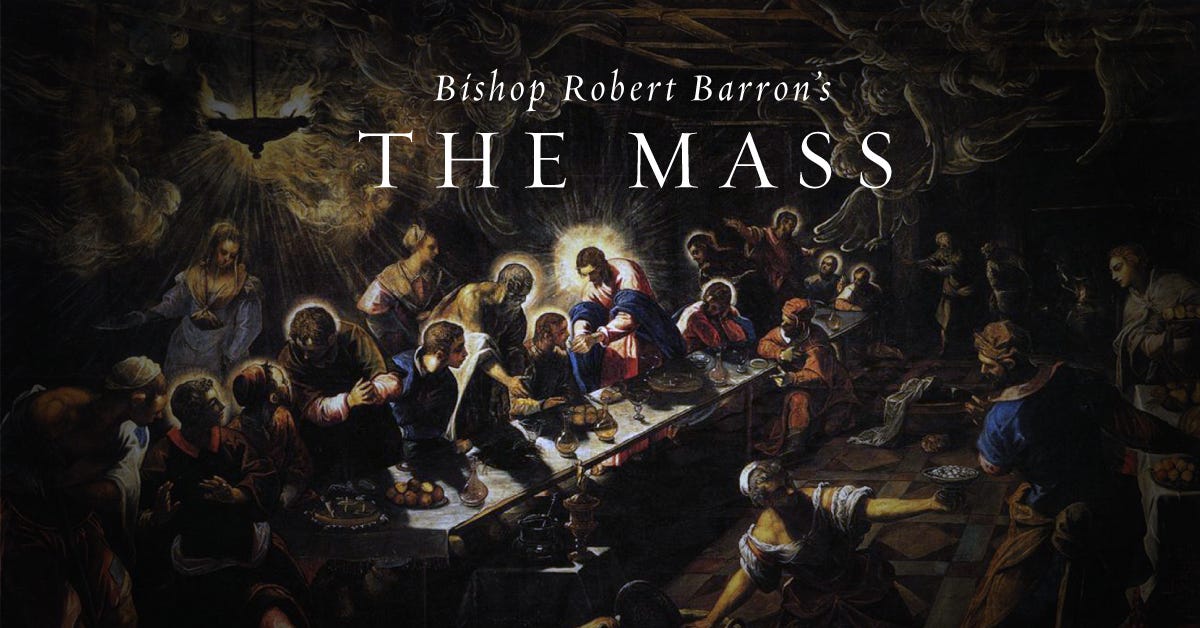
This series of reflections by contributor Dan Sherven is based on his experiences and learning while participating in Bishop Robert Barron’s The Mass . This study program, including readings and videos, often carried out in a group, provides a biblical walk through the Liturgy of the Mass, promising transformation through “this most privileged and intimate encounter with our Lord Jesus Christ this side of heaven.”
Bishop Robert Barron’s The Mass: Reflection One
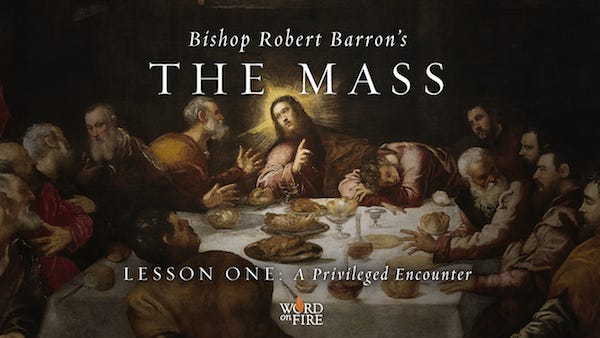
Our Enlightenment inheritance is to think that our reason is better than our faith. It’s a sign of the times to try and rationally dissect the Trinity or the miracle of the Eucharist. Perhaps the point of both of these things, in a sense—is that God wants us to trust Him rather than reason about Him.
Many Protestants hold that the Eucharist is only a symbol. The Eucharist is a symbol, but it participates in a greater Reality. It is both; it is not only a symbol but also symbolic. Maybe that is where much of the confusion around the ‘real presence’ of Christ comes from. The Eucharist is a symbol of Christ’s body and blood, and it also really is His body and blood. The Eucharist is a symbol, which is the Reality it symbolizes.
Also, angels are present at Mass. However, people tend to think of angels as heavenly human beings with wings. Yet the work of Orthodox thinker Jonathan Pageau, drawing on the Church Fathers, points to angels and demons as intelligences. Angels and demons are spirits without a body. That is why there is always something seriously lost when angels are represented as human bodies.
There’s no better visual solution because one is trying to represent something that exists only in the spirit and does not have a body. In the end, given our intelligence, people are the closest created creatures to angels. But angels and demons are better thought of as intelligences which influence us. Angels and demons aim to have humans be their bodies. In this light, a good idea could be seen as angelic, and a deeply sinful idea demonic, but there is no outside human figure involved in bringing either idea to a person’s attention.
In terms of spiritual reality breaking into physical reality, Psalm 85 states that “Truth will spring from the earth.” Christ says in the Gospel of John: “I am the Way, the Truth, and the Life.” Christ is the Word or the Logos, the Truth Who springs from the earth. The Christian revelation is that the Truth is a person, Jesus Christ. Author Matthieu Pageau notes that in Biblical cosmology, the word ‘earth’ means material reality. So again, Psalm 85 points to Christ. Seeing as Christ fully takes on the matter of the created world, in becoming Man, to save us.
We also have reflections from Thomas Merton, the Catholic writer who was influenced by Buddhism and Daoism. He mentions how language can only have meaning because there is silence between the words. Merton is thinking of the great silence one experiences in the Mass. And he says that during Mass, we hear the Divine Mercy in that silence.
Merton writes elsewhere that the Dao is the Spirit of God. Vatican II notes that other world religions have “rays of truth in them.” And the Dao is often described as water. So, the Holy Spirit could also be described as water. Considering that the Spirit is the eternally flowing source of life. We flow in the Spirit. Knowing not where the Spirit comes from, nor where It goes.
We are given a great emphasis on being rather than doing. That includes the story of Martha and Mary, two sisters whom Jesus visits. Mary is busy cleaning and organizing things in the house. She somewhat scolds Martha, who is simply sitting in the presence of Christ. Yet Jesus approves of Martha’s still approach. As Psalm 46 reminds us, “Be still and know that I am God.”
There’s mention of Saint John Paul and his idea that a person has to be before one can do. Again, harkening to Psalm 46. Yahweh is the Hebrew verb to be. Because when God reveals His name to Moses—after Moses takes off his sandals, which would be used for working, God says His name is “I AM.” God is the Existing One on which all subsequent existence is dependent. We are called to sit and be still before I AM.
That’s the essence of play—to be still—then become more to be rather than to do. Bishop Barron notes how the Mass is the most useless activity, which is to say that Mass is the highest activity because Mass is pure play. It is not sacrificial work that is done for a secondary purpose, such as to gain money. Instead, Mass is done for itself, as all great play is. “Heaven is a playground,” says the Catholic writer G.K. Chesterton.
Integral to play is the idea of encountering Christ. We are given a quote from Pope Benedict XVI before he became Pope, so he was then Cardinal Joseph Ratzinger. In 2005, at the funeral of Luigi Giussani, who was the leader of the liturgical reform movement, Ratzinger said: “Christianity is not an intellectual system, a collection of dogmas, or a moralism. Christianity is instead an encounter, a love story, an event.” Christianity is primarily a relationship with Jesus.
Bishop Robert Barron’s The Mass: Reflection Two
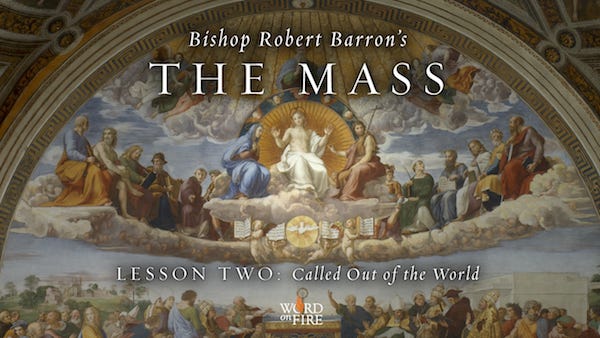
Early on in the Mass, there’s a section of worship called the “Gloria.” That’s when we give glory to God in the highest. It produces peace on earth. Because when we make God the highest point of our attention, lifted up, everything else falls into place. The Suffering Servant, Christ, is the archetype which makes everything else work properly—if Christ is in the highest.
That peace arrives both in our individual lives and in Christian societies. When heaven is the highest, earth works. In other words, when Spiritual Reality is worshiped correctly, all things in material reality can play their proper role, even though that proper role could still be rife with suffering. It’s at least righteous suffering, which should be easier for us to bear, with Christ.
The highest point of our attention is the same thing by definition as that which we worship. Bishop Barron says that when we give “glory to God in the highest,” it’s an expression of humility and proper praise. The inevitable result is peace “in me and around me.” The alternative—having something other than God be the highest point of attention—is by definition idolatry. The result is something far from peace on earth. Immediately, things get placed wrongly. Our focus is off.
There are many things about Christ and God that we cannot know while we are alive. But it’s important that we remain in the “cloud of unknowing.” In Second Chronicles, the Israelites are unable to continue their worship because God—as a cloud—descends into the Temple and obscures all vision. We can think of incense as a tangible sign of this, which purifies the area and provides a cloud of unknowing. We must be comfortable with not knowing because that’s often what faith is.
Faith is both to trust in things unseen as well as the evidence of things not seen. There is a divine darkness that the great mystical writers talk about, where we begin to realize that we don’t truly know God at all. A space where it would make more sense to say God does not exist, because our category of existence cannot hold God. While God’s energies do act in the world, such as the cloud in the Temple, the essence of God remains fundamentally unknown.
There is something to be said for aspects of liturgical worship that are not propositional. Meaning, things including ritual actions which are not primarily ideas. Embodied participation, going through the procedure of singing, reorients one’s perspective to the divine darkness. These are non-propositional forms of knowledge are an antidote to the digital age, where nothing is incarnate and everything is ideas. As Saint Gregory of Nyssa writes: “Wonder leads to knowing.” Here, he is talking about knowing through not-knowing.
In the Kyrie Eleison, “Christ have mercy,” we have the Greek word eleos, which is translated into English as mercy. But eleos also comes from a Greek word for olive oil, which was used to heal wounds. Here we are reminded of the Eastern Orthodox Christians, who describe the Church as a hospital for sinners. There is, then, a focus on divine mercy and healing, rather than divine justice and punishment. In the West, unfortunately, we often think of the Church as a courtroom rather than a hospital.
Our reading states that “God is the Holy Spirit who glorifies and magnifies all of creation, including us as we allow.” God comes as close to us as possible, in this life, without His presence becoming a painful burning. In other words, God is experienced as burning by those in a state of sin, and as joyful light by those in a state of grace. If God were to approach us with more presence than we could handle at that moment, it would indeed be a burning rather than a joy.
Author Rumer Godden says that “one of the good things about the Catholic church is that it isn’t respectable. You can find anyone in it, from duchesses to whores, from tramps to kings.” The ‘judgmental church person’ is too busy judging themselves and their own sins to care about judging the newcomer at Mass. The people at Mass are hopefully the people who are most aware of their own sins. That is, hopefully, why they are there. One is reminded of the Jesus Prayer: “Lord Jesus Christ, Son of God, have mercy on me, a sinner.” Or sometimes, “the sinner.”
Christ says in the Gospel of John: “Without Me, you can do nothing.” For as Saint Paul later writes in First Corinthians, God’s weakness is greater than our strength. The people at Mass are hopefully the people who most recognize themselves as sinners. These people are there because they are actively trying to better themselves through God’s weakness, not their own strength, which is itself a stance toward life that is unknowing.
Bishop Robert Barron’s The Mass: Reflection Three
“They’ve been sacramentalized, but never truly evangelized. Having never quite experienced that cognitive moment of encounter with Christ,” says Bishop Robert Barron. Building someone up through the Catholic intellectual tradition to give them a propositional, idea-based encounter with Christ is good, but a real encounter with Christ, especially through the Church’s ritual, is much more than intellectual. A real encounter with Christ is done through the nous.
Nous is the Greek word which we translate as heart, sometimes as intellect. Nous is a combination of the heart and mind, but nous is also a direct, intuitive perception of spiritual reality. A perception which is not intellectual. It is a seeing with the heart, entering directly into relationship with God.
Nous reminds us: “We can do nothing perfectly of ourselves, but much can be achieved through us, if we are open conduits to the workings of God.” The limited condition of humanity leads us into thinking we know better than God. But clearly the Infinite can see our life more clearly than we can. That is why we should lead with nous. The nous is how we allow the Spirit to dwell in us. Becoming conduits for the work of the Word, more so than being the fruits of our own thought.
“‘In the beginning was the Word,’ writes John in his Gospel. We are attending to a God who actually speaks—who actually communicates. The creation of the world was formed on the force of God’s Word—spoken into being, ‘thought into being’ as it were, and there is an eternal call-and-response extent within creation.”
In our reading, we find that “God forms his people and [sends] the patriarchs and the prophets forward. ‘The Divine Voice is becoming clearer, more focused, more intelligible.’ [The Divine Voice] speaks to us from ancient days until today, and brings forth the Word Made Flesh, who is Christ Jesus.” There is a growing clarity emerging from paganism, extending through the Old Testament that ultimately culminates in the person of Christ.
Saint Irenaeus fought against Marcion of Sinope for the inclusion of the Old Testament in the Bible, which brings in the Jewish scriptures. This makes the figure of Christ even more complex. Not only does Christ’s mercy cast light back through the Old Testament, but the Old Testament God’s strength casts forward onto the dying Savior. With both Testaments, we are given a more complete picture of right praise.
In terms of right praise, “the Father speaks his Word (the Son) and that Word is interpreted by the Holy Spirit.” That statement leads us into the debate between objective revelation and personal interpretation. This is one of the main points of contention between Catholics and Orthodox, when compared to some Protestants, with Catholics holding that the Church’s interpretation is authoritative.
So, in Catholic Mass, during the Liturgy of the Word, we are participating in what Bishop Barron calls “the story of our being drawn evermore into the right praise of God.” As our reading states, that is “the great narrative we all belong to.”
In this Liturgy of the Word, the Psalm follows a moment of silence. One must remember Christ’s words on the cross: “My God, My God, why have you forsaken Me?” Those words are from Psalm 22, which ends with the line: “They shall come, and shall declare His righteousness to a people that shall be born, that He has done this.” There is an image of resurrection here, as Orthodox thinker Jonathan Pageau notes, and an image of the birth of the Church. It is the Man-God who speaks these words from the cross, echoing the human despair and range of emotions found in the Psalms.
“‘They knew Him,’ marvels Bishop Barron, ‘and our faith comes not from abstract speculation, it comes not from deductive reasoning, it comes not from mythology.’ It comes, rather from ‘this little band of twelve that gathered around Jesus and knew him.’” Our reading states that “the faith of the Church is apostolic, not some vague spirituality.” Meaning that “the Christian faith is not a privately-generated, religious philosophy, rather it is the fruit of the apostolic witness.”
Bishop Robert Barron’s The Mass: Reflection Four
Bishop Barron tells the story of learning to play baseball and how the coach had the kids first get to know the grass. As there’s much more going on in life than propositional statements about reality. Christianity is not primarily a philosophical system, but a real encounter with the Living God.
In reference to the baseball coach, Bishop Barron says, “We need a good mystagogue, a guide, someone who will move us through the thicket of the biblical world, helping us to understand it and then see our relationship to it. We need, in a word, a preacher; we need a homilist.”
Mystagogy is a Greek term, meaning “to lead through the mysteries.” A mystagogue is someone who helps us with scriptural interpretation, but in a way that shows us the practical application.
Author Matthieu Pageau notes: “If you know the Bible very well and you understand the stories, you might start to discover that the patterns that are described in the Bible are also happening to you. All the time. Whether you want it or not, by the way.” For, as our reading says, “once people have seen how their lives are illumined by the Biblical pattern, they will want to make their lives a living sacrifice of praise to God.”
Our reading talks of the apostle Philip in the Book of Acts, where he is reading a quote taken from Isaiah: “Like a sheep he was led to slaughter, and as a lamb before its shearer is silent, so he opened not his mouth. In his humiliation, justice was denied him. Who will tell of his posterity? For his life is taken from the earth.” Philip brought that quote to an Ethiopian who was open to Christ.
In this way, Philip was a mystagogue for the Ethiopian as the apostle “went beyond scriptural expositions into dynamic witness, and it was the combination of the two that filled the Ethiopian with a desire to proclaim Christ himself through becoming baptized, thereby beginning a lifelong engagement with mystery through an encounter of intimacy.”
Propositional knowledge, thinking about ideas, and using words is fine, but as the cognitive scientist John Vervaeke points out, there are other forms of knowledge, such as playing a sport, which are not strictly about ideas. The Catholic Mass, with its focus on the body, offers us an experience which is more than words. We also cannot describe the experience of Mass in only words. Because an encounter with the Word made Flesh demands the entirety of the person.
Bishop Barron teaches us how every baptized person, whether male or female, is a “Priest, Prophet and King.” That idea is inspired by the First Letter of Saint Peter, where we find that those who are in Christ are a “royal priesthood.” Protestants often hold that phrase to mean that anyone can be a minister, and confession through a priest is not necessary.
But as Orthodox thinker Jonathan Pageau points out, the phrase ‘royal priesthood’ is “referring to a verse in the Old Testament in which it says that Israel is a nation of priests. Now, what Peter is doing is applying it to Christians. He’s saying, like Israel was a nation of priests, so too now this priesthood is extended to all those that enter into Christ; they are now Israel for all intents and purposes. But in the Old Testament, the phrase didn’t mean that everybody was a priest in terms of function.”
This distinction between function and identity is crucial, especially in how we understand the priest’s role within the liturgy. Pope Benedict XVI stated, for example, that “whenever applause breaks out in the liturgy because of some human achievement, it is a sure sign that the essence of liturgy has totally disappeared and been replaced by a kind of religious entertainment.” If there is applause, we are applauding the priest as the individual he is, the man, rather than noticing that he is a representative of Christ on earth.
Our reading has the story of the adulteress whom Christ does not condemn. For Christ does not condemn anyone, as the writer John Marsh notes. It is each individual’s choice in how they respond to the reality of Christ, accepting or rejecting Christ, which either frees or condemns a person.
The story of Christ not condemning the adulteress, who accepts Christ, shows the reader that we are “forced into a recognition of self that severs any lingering attachment to a judgmental mob mentality … we too must express gratitude for mercy.” Because we also are “both liable to right judgment,” and “the beneficiaries of unearned mercy.” We have our own sins to focus on. And as Christ says, with a phrase to echo forever: Let he who is without sin cast the first stone.
During the Mass, in response to us having heard the Word spoken through the Gospel, we move on to a request. Bishop Barron notes: “Having heard all you have done, Lord, having sensed that we’re a part of that story, now we have the confidence to stand up and ask, ‘Lord, may you do something just as great for us.’” Protestant pastor Paul Vander Klay says that we honour a king by making a kingly request.
Sometimes we should ask for the impossible, from the King of Kings.
Bishop Robert Barron’s The Mass: Reflection Five
In the Eucharistic Prayer, we are “lifting up our hearts to the mountaintop and beyond to heaven.” As there is always a symbolic relationship between mountains and heaven. Bishop Barron notes how “‘the Garden of Eden, in the poetic imagination of the author of Genesis, was a mountain.” We know that because the rivers flow forth from it, from a height.
“Where was the Law given, but on Mount Sinai? Where was the Temple built, but on Mount Zion? Where was the Transfiguration? On Mount Tabor. Where was the Crucifixion? On Mount Calvary. Mountains are places of heightened consciousness, where humanity and divinity meet.’ When we say we are lifting our hearts, we are going up the Holy Mountain. ‘We’re going to the place of sacrifice, where Christ draws all people, all creation, to himself.’”
We see how in the Preparation of the Gifts “The same way that a new baby represents the co-creative consent and co-operation of a married couple with the will of God, the bread and wine represent our co-creative co-operation with the Creator and with the fullness of all that he has made.” Here we are reminded of J.R.R. Tolkien’s term sub-creation, which he uses to talk about us being sub-creators beneath God. God gives Adam His work, tending the Garden of Eden. God has the priest consecrate the bread and wine and make a miracle happen; God ‘uses’ us.
During Mass, collection baskets are sent out to gather donations. “We should not think of the collection of money as some sort of banal, dirty, but necessary affair. Money is our work. Money is hours of our lives. And now we give it away, we sacrifice for it, for the work of the Church.” The Church uses our donations for the Church’s “work of charity and evangelization.”
Our donations “communicate a message of constancy and commitment to the mission. Collectively, they say ‘let this work, this announcement of salvation through the death and resurrection of the Christ go on, let our outreach to our neighbors continue and expand, let our church workers be enabled to feed their families and pay their bills so they can remain in place, for stability, let our buildings be safe, suitable dwellings fit for worship and fellowship and communion, and attractive enough to invite seekers.’”
And as our reading notes, in a sense, our donations are us, “in the measure with which we dare to give ourselves to [God].” Monetary sacrifices remind us of how “Cain and Abel make burnt offerings to the Lord, each setting aside a portion of their productivity (of grain and flock, respectively) to the Lord as an act of praise, gratitude, and humility.”
Then, in the context of the Eucharist, “all our gifts and sacrifices are returned to us changed, made better, transformed through the action of God. In Genesis, we saw Cain making an offering of cereal to the Lord, while Abel offered flesh, which was the better offering. [In the Mass, the priest has] offered bread made of grain, [but] it will be made into a better offering of flesh.” Yet Cain became resentful, shaking his fist at God, when it was Cain’s own fault that he offered a lesser sacrifice than Abel did.
Christ has a parable about the nature of proper sacrifice, something which Cain did not do: “A poor widow also came and put in two small coins worth a few cents. Calling his disciples to himself, he said to them, ‘Amen, I say to you, this poor widow put in more than all the other contributors to the treasury. For they have all contributed from their surplus wealth, but she, from her poverty, has contributed all she had, her whole livelihood’” (Mark 12:41-44).
Therefore, we must remember, as Saint Bernadette points out, “God is never outdone in generosity.” Our reading shows us how the lives of saints are often in agreement, in noticing that “the catalyst for a continual increase in blessings begins with giving portions of oneself away—of making sacrifices both large and small, always trusting God. ‘Your being increases in the measure that you give it away,’ [Saint] John Paul said. He called it ‘the law of the gift.’”
Bishop Barron says that “to be filled with God is to be filled with love, which is to say, self-emptying. The moment we receive something of the divine grace, we should make of it a gift, and then we will receive more of the divine grace. In a word, our being will increase in the measure that we give it away. This is the water welling up to eternal life that Jesus speaks of.”
Bishop Robert Barron’s The Mass: Reflection Six
“God’s word does not describe, it creates.” And Christ is God’s Word. Which means that the statements Christ makes, about the Eucharist, or about the sacrament of confession being conferred only to the apostles and their successors, these statements cannot be watered down or taken away because God’s Word creates reality.
God’s Word creates, which might be why Western Christianity added the filioque to the Nicene Creed. Filioque is a Latin word which means ‘and the Son.’ So the changed Creed is: “the Holy Spirit proceeds from the Father and the Son.” However, it’s also perfectly Catholic to say “through the Son.” The Holy Spirit proceeds from the Father through the Son.
The Word, the Son, is the ‘processional instrument’ of God. The Father uses the Word to create all things at the beginning of time; including time itself. Now the Holy Spirit is not a created thing, but He is also not begotten. The Holy Spirit proceeds from the Father. However, for anything to exist—and ‘thing’ here does not mean created object—perhaps ‘it’ must proceed, be ‘created,’ through the Word. So the Holy Spirit proceeds from the Father, through the Son.
In the Mass, the Trinity is present and “God wants to feed people with his very life.” Christ says: “I am the bread of life. Your ancestors ate the manna in the desert, but they died; this is the bread that comes down from heaven so that one may eat it and not die. I am the living bread that came down from heaven; whoever eats this bread will live forever; and the bread that I will give is my flesh for the life of the world.”
And “‘the Eucharist is the tie that binds us to everybody else.’ Says Bishop Barron, both on earth and in heaven—saints, angels, and martyrs included.” Communion is community. That was especially true historically, as the Church was the gathering of the entire village and the saints.
Author Matthieu Pageau notes how, when things are complex, they appear to us as clouds or darkness. But when things are extremely simple, those ideas are often so fundamental to our perception that we have trouble seeing them. Things can be so clear that we see right through them. And in the course of the Mass, “the ‘cloud of unknowing’ is about to dissipate.”
But it can be hard to see that we are really going to be eating Christ’s body and drinking his blood. When the Word speaks, God creates: “Jesus said to them, ‘Amen, amen, I say to you, unless you eat the flesh of the Son of Man and drink his blood, you do not have life within you.’”
Now, “the Council of Trent affirmed that [the real presence of Christ in the Eucharist] occurs, by the power of the words spoken [by the priest, who is acting in the person of Christ]. The words of Jesus as God become what is. ‘Daughter, your faith has healed you,’ and a woman is healed. ‘Lazarus, come forth,’ and a dead man walks out of his tomb. ‘Little girl, arise,’ and a child returns to her family. When the Second Person of the Trinity says, ‘You will be with me in Paradise,’ there is cause for rejoicing because it is an assured reality. When he says, ‘Behold your mother,’ his mother becomes our own.”
Christ also talks about how “faith ‘the size of a mustard seed’ can move mountains.” Here, Christ is speaking metaphorically. Although perhaps if a person really did have enough faith, God would move a mountain for that person. Much as the Red Sea was parted. The point is that even a small amount of being able to stand on God, to trust in God, is enough for radical change. One can think of examples of strong faith leading to radical change, such as Mary’s “yes”.
Then “the priest, recalling Christ’s words, ‘I leave my peace, my peace I give to you,’ brings to mind the great ‘Shalom’ with which the Resurrected Christ greeted the apostles.” For God is peace. Even after being murdered, as Saint Paul notes, “the God we killed returned to us ‘in forgiving love.’” We can only find true rest in that God of love, as Saint Augustine tells us.
God’s word creates reality, and the Logos is relationship. Therefore, Christ is really present in the Mass. Pope Benedict XVI wrote, while still Joseph Ratzinger, “Christ exists from the Father and for mankind.” Christ’s whole being is for other people. His work and being are the same thing.
Bishop Robert Barron’s The Mass: Final Reflection
“Soon there comes a profound quietness—a brief instant of peace ‘beyond all understanding’ so authentic, so true, that even children seem to recognize it.” As the priest holds the Eucharist high for an Eternity. Abbot Jeremy Driscoll notes how “something is hidden under the appearance of the bread and wine. Faith perceives it.” And “after the celebrant elevates both Body and Blood so that we may see and adore, he will genuflect in adoration before them both, and solemnly declare, ‘The mystery of faith.’”
Heaven and earth have been reconciled in Christ. He is the New Adam, the perfect mediator between God and humanity. We are called to be unifiers of heaven and earth. Christ does that, offering Himself as a perfect sacrifice as only God can, which opens the doorway that He is, for us to become God, as much as it is possible for humans to do so—to use the saying of Saint Maximus the Confessor—because Christ is fully human, a bridge.
“‘This theme of eating and drinking with the Lord runs right through the Bible,’ Bishop Barron says, ‘calling to mind God’s instructions to Adam and Eve that they eat; his order that the Hebrews enslaved in Egypt eat a Passover meal; Isaiah’s vision of the heavenly banquet; Jesus sharing meals with priests, Pharisees and tax collectors; the Last Supper; and the first Masses as they are described in the Acts of the Apostles and in the Epistles.’”
There is also Abram, who has his wife, Sarai, set the table for the three strangers, who turn out to be angels, for it is said that through proper hospitality, some have unknowingly entertained angels, which can and does happen in Mass, too. However, we can become aware of that reality.
“God doesn’t need sacrifice. Therefore, it comes back to us. Now, we are going to eat and drink the Body and Blood of Christ, which we have offered to the Father,” Bishop Barron says. So sacrifices which are given up return to us in a more pure form, as Orthodox thinker Jonathan Pageau notes.
Now it’s time to enter fully into the mystery of the Mass: Communion.
Our reading points out, how sometimes after receiving the Eucharist, people will cover their faces in prayer: “The Reality of Christ within the Eucharist—the idea of the Son of God willingly enduring an unjust, terrible death to share in his broken body with his people that they might rise into Eternity with him—that’s a lot to take in.”
In due time, “the Mass is ended. Everything has been said; a sacrifice has been made; a meal has been eaten. It is finished. (Jn 19:30).” The Latin which the priest, or deacon, would say at the end of Mass is: Ite, missa est. A literal translation would be “Go, it is sent.” For “once Noah’s Ark came upon land, Noah opened the doors and shooed out the animals. He ‘let the life out,’ as Barron puts it. It was necessary to do so in order to renew the face of the earth.” So, “we too now must go to let the life of Christ within us out in order to renew the face of the earth, one encounter at a time.”
In the Mass, as Bishop Barron notes, “‘We are gathered, we are fed, and finally we are sent’ back out into the world to evangelize.” Sometimes, it’s the relationships and how other people perceive the Christian after interacting with them that serve as the evangelization.
Pope Benedict XVI writes about the end of the Mass: “Ite, missa est. These words help us to grasp the relationship between the Mass just celebrated and the mission of Christians in the world. In antiquity, missa simply meant ‘dismissal.’ However, in Christian usage it gradually took on a deeper meaning. The word ‘dismissal’ has come to imply a ‘mission.’ These few words succinctly express the missionary nature of the Church.” God trusts us with His work on earth.
We leave the Mass and embark on a life of evangelization, whatever that looks like in our individual lives, remembering the Sacrifice of Praise: “Trusting in and praising God under all circumstances; surrendering your free will to God’s will for your life.” That’s what we learn to embody, not think, through the Mass. Standing on, and trusting in, the Ground of Being.
Watch Bishop Robert Barron’s The Mass through Word on Fire Catholic Ministries. Learn more about Bishop Robert Barron’s The Mass.
“Walk through the Liturgy with Bishop Barron and be transformed though insights on this most privileged and intimate encounter with our Lord, Jesus Christ. See how the Mass brings us out of the fallen world and into the heavenly realm, how it revolves around a call from God and a response from his people, the Church, and most importantly, how we are intimately joined with the Body, Blood, Soul and Divinity of Jesus through the Holy Eucharist.”
Dan Sherven is the author of four books, including the number one bestseller Classified: Off the Beat ‘N Path and Uncreated Light. Sherven is also an award-winning journalist, writing for several publications. Find Sherven’s work.